Color can separate a vessel from a nerve, but color alone cannot communicate every physical difference within a printed anatomical model. Flexible and rigid structures behave differently when handled, transparent material can expose an enclosed pathway, and an opaque surface can strengthen visual boundaries. Multi-material printing brings these properties into the manufacturing process so that form, visibility, and touch can be assigned according to the teaching purpose of the model.
Why More Than One Material Can Be Useful
A 3D model of blood vessels may contain fine branches beside nerves and other hand structures with different shapes and handling requirements. Printing every component with the same material properties can preserve the overall form, but it may limit the physical and visual cues available to the learner.
Material contrast can make an internal route easier to follow. A softer component may remain distinguishable from a rigid support, while transparent packaging material can reveal a colored pathway without leaving it fully exposed. Opaque material, by comparison, can create a clear external boundary where internal visibility is unnecessary.
The teaching objective determines whether these differences are useful. A model intended only for visual demonstration may prioritize color and clarity. A model handled repeatedly may also need suitable strength, flexibility, and protection for narrow printed structures.
Material contrast is most effective when it follows an anatomical rule. Consistent properties can distinguish one network from another across the entire hand, whereas arbitrary changes may cause learners to interpret a manufacturing choice as a biological difference. The legend and physical design therefore need to communicate the same classification.
Inkjet Deposition and Light Curing
DIGIHUMAN describes a full-color, multi-material process that combines inkjet and light-curing technologies. Inkjet deposition places controlled amounts of printable material, and light curing solidifies the deposited material so that successive layers can build a three-dimensional object.
Layer-by-layer production allows color and material properties to be distributed across complex geometry. The method is especially relevant when several narrow structures follow different paths through the same region. Their separation must be maintained through the print rather than added only as surface paint afterward.
Light curing also influences how successive deposits become a stable object. The printing process must maintain the intended geometry and material placement as successive layers are produced, particularly around fine branches and junctions. Printing accuracy depends on coordination between deposition, curing, support, and the digital geometry supplied to the machine.
Printing remains the final stage of a longer anatomical workflow. Digital geometry, branch continuity, surface preparation, and material assignment all influence whether the physical result preserves the intended anatomical relationships.
Twelve Channels Expand Material Combinations
The printer is described as having 12 material channels. Multiple channels permit combinations to be managed within one production process, including single-hardness material, soft-and-hard composite material, and transparent package material.
For a 3D model of blood vessels, channel capacity can support several visible or physical distinctions without requiring every structure to be manufactured separately. A vascular branch may use one color or property, a neighboring nerve another, and a surrounding transparent component a third.
Channel count does not determine anatomical accuracy by itself. It expands the available manufacturing options. The usefulness of those options depends on correct segmentation, suitable material assignment, and a print design that keeps small structures identifiable rather than visually crowded.
The channels can be understood as a palette of controllable material inputs rather than twelve anatomical categories. Several inputs may be combined to create a required color, hardness, or transparency. The final effect depends on how the production plan distributes those properties through the model.
From Material Choice to Printed Effect
The effects listed for the broader DIGIHUMAN workflow include full-color hard printing, soft-hard composite printing, and full-color soft printing. Transparent or opaque molding materials can be used according to the desired result.
The listed print effects correspond to distinct practical needs. Hard printing can provide dimensional stability for a demonstration object. A soft-hard composite can distinguish flexible pathways from supporting anatomy through touch as well as sight. Full-color soft printing can combine visual coding with a different handling quality, while transparent material can preserve visibility around enclosed structures.
These choices also involve tradeoffs. Added softness may affect support requirements, transparency may reveal internal routes but reduce surface contrast, and many colors can clarify networks only if the coding remains consistent. The most informative model is not necessarily the one using every available effect.
Applying the Process to Hand Vessels and Nerves
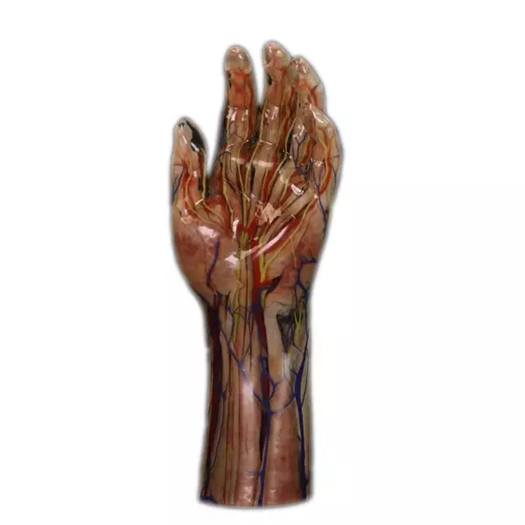
The Hand Blood Vessels and Nerves model provides a concrete use case for multi-material printing. Its crowded anatomy requires branch continuity, controlled color separation, and sufficient support for fine pathways. A 3D model of blood vessels can then be examined together with neural routes rather than as a vascular network detached from the hand.
DIGIHUMAN describes its 3D printing workflow as using full-color, multi-material printing with inkjet and light-curing technologies, a 12-channel printer, and options that include hard, soft, transparent, and opaque materials. These are manufacturing facts rather than a claim that one configuration suits every lesson.
Material variety becomes educationally useful when it clarifies a real anatomical distinction. For hand study, the physical model should preserve the spatial relationships among vessels, nerves, and surrounding structures while using material differences where they improve visual or tactile differentiation